Bee and Wasp Removal in Manhattan: When to Call a Professional
Bees in your Manhattan building's brickwork, AC sleeve, or window frame? Knowing whether you have honey bees, yellow jackets, or carpenter bees determines your next move.
Bees and Wasps in Manhattan Buildings: A Common Call
Every spring and summer, Manhattan residents notice flying insects entering or exiting gaps in brickwork, AC sleeves, window frames, rooftop parapets, and exterior building voids. The question of whether to call immediately, wait it out, or handle it yourself depends entirely on what species you are dealing with — and that identification determines whether you need a pest control professional or a beekeeper.
The Three Most Common Calls We Get About Bees in Manhattan
1. Yellow Jackets in Wall Voids or AC Sleeves
This is the most common call and requires professional treatment. Yellow jackets are wasps — not bees — and are aggressive defenders of their colony. In Manhattan buildings, they frequently establish nests inside the wall void space accessed through gaps around AC sleeves, gaps in brick mortar, and openings at roofline edges. A colony that began in April with a single queen will have 1,500 to 5,000 workers by August. They sting without provocation when their colony entrance is disturbed, and disturbing an established wall-void nest without proper equipment and product is genuinely dangerous.
What to do: Do not seal the entry point. Do not spray the opening. Call a professional who can treat the void space directly using residual dust or foam formulations. Treatment is typically complete within 24–48 hours, after which the colony entrance can be sealed.
2. Honey Bees Entering a Wall Void or Chimney
When a honey bee swarm — a ball of thousands of bees resting temporarily on a fire escape, tree, or building exterior — scouts a gap in your building and moves in, you have a different situation than yellow jackets. Honey bee colonies inside walls build honeycomb and can establish for years. Honey bees are important pollinators — a licensed beekeeper is the right professional to handle a honey bee colony, and many beekeepers will do so for free or low cost, particularly in spring when a colony is newly established.
What to do: We do not treat honeybees; if a colony is confirmed as honeybees rather than wasps or hornets, we refer the matter to a licensed beekeeper. A pest control professional can confirm whether the insects are honeybees or yellow jackets and treat yellow jacket or wasp nests. Note that untreated honey bee colonies that die inside walls leave honeycomb that melts and creates moisture and attractant problems for years.
3. Carpenter Bees on Window Frames, Decks, or Rooftop Structures
Carpenter bees are solitary wood-boring bees that drill perfectly round entry holes in soft, unpainted, or weathered wood. On Manhattan terraces, rooftop structures, and building facades with exposed wood elements, they drill into fascia boards, railings, and decorative trim. A single season of carpenter bee activity leaves characteristic 3/8-inch-diameter holes and can weaken structural wood over multiple seasons of use.
What to do: Treat existing holes with residual dust before sealing, then seal with wood putty and paint or stain. Professional treatment in spring before females begin nesting prevents new galleries. Carpenter bees are not aggressive unless directly handled — males cannot sting.
Paper Wasps Under Balconies and Window AC Units
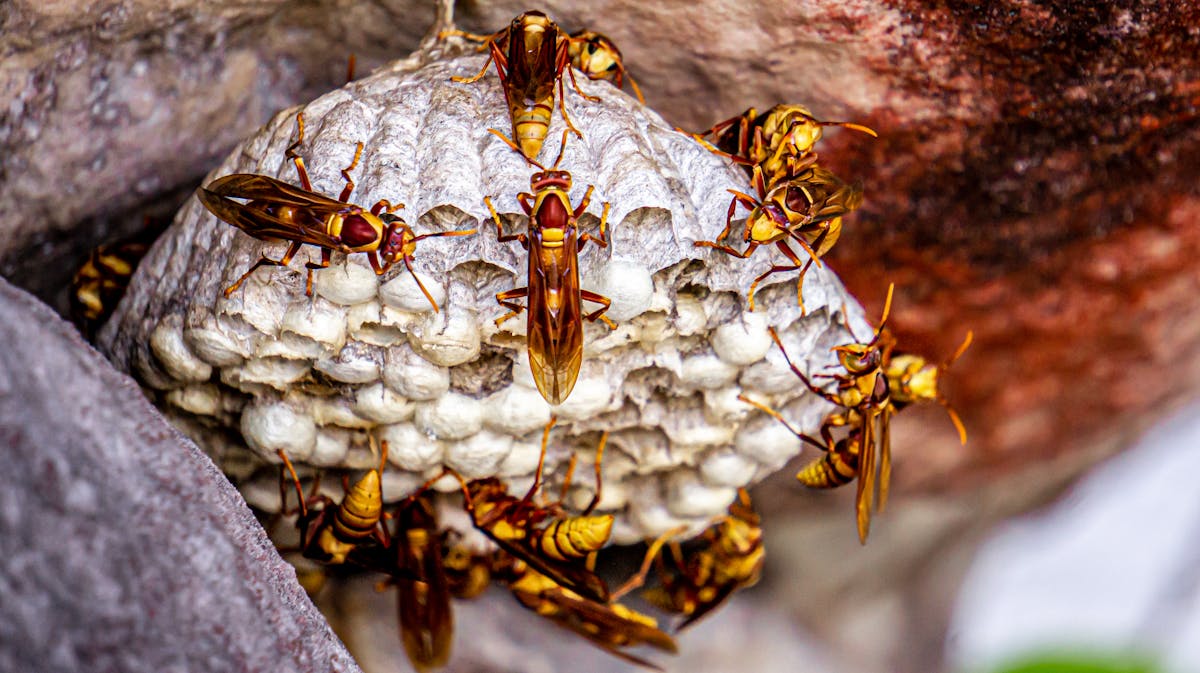
Paper wasps build small, open-celled nests under balcony overhangs, beneath window air conditioner housings, and in protected exterior locations throughout Manhattan. They are far less aggressive than yellow jackets and will not pursue humans away from the nest, but direct nest disturbance will trigger defensive stinging. Small nests (golf ball size or smaller) can be treated and removed with retail aerosols if done carefully after dark when wasps are inactive. Nests larger than a tennis ball near frequently used areas should be professionally treated.
Why DIY Removal Often Makes Things Worse
The most common mistake Manhattan residents make is sealing the entry point of an active colony. Blocking the entrance traps thousands of insects inside the wall. They detect the barrier, begin attacking from inside, and can chew through drywall to exit into the living space. An indoor emergence from a large yellow jacket colony in a Manhattan apartment is a genuine emergency that requires evacuation and professional treatment. Never seal an active colony entrance.
What Professional Bee and Wasp Removal Includes
Professional treatment begins with species identification — the correct approach depends entirely on what is nesting. After identification, we assess all entry points, determine nest location and size where accessible, and treat using appropriate professional-grade products with full protective equipment. For yellow jackets, this typically includes residual dust in the void space via the colony entrance. After treatment is confirmed complete (24–48 hours), we advise on sealing the entry point to prevent re-colonization the following season.
If you have bees or wasps entering your Manhattan apartment or building, call Manhattan Pest Control Near Me at (646) 961-3700. We handle yellow jackets, paper wasps, carpenter bees, and bald-faced hornets throughout Manhattan — Upper East Side, Upper West Side, Midtown, Chelsea, Greenwich Village, Harlem, and beyond. Honeybee colonies are referred to licensed beekeepers.